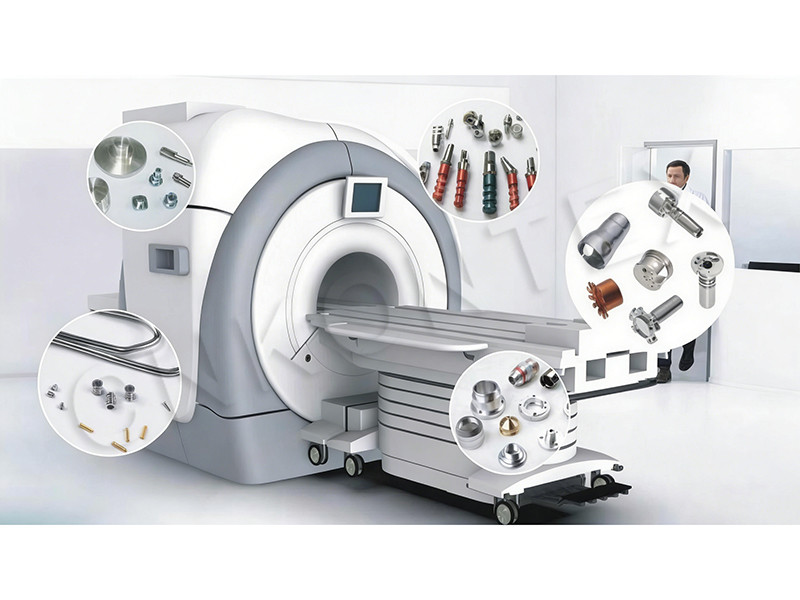
Production Process Of Precision Parts For Medical Instruments
Release time:2026-01-31
Visits:270
The production process of precision parts for medical instruments is a rigorous, technology-intensive workflow, strictly regulated by international and national medical standards to ensure ultra-high precision, biocompatibility and reliability. It covers core links from raw material selection to delivery, with strict quality control throughout.
Raw material selection is fundamental, prioritizing medical-grade materials like 316L stainless steel, Ti-6Al-4V ELI titanium alloy, cobalt-chromium alloy and PEEK polymer, selected based on application scenarios. All materials have FDA, CE certifications for traceability and undergo strict incoming inspection. Pretreatment includes ultrasonic cleaning to remove contaminants, heat treatment to reduce internal stress, and surface passivation for corrosion resistance, all in a clean environment.
Before mass production, CAD software designs 3D models with dimensional tolerances (±0.001mm to ±0.01mm) and surface roughness (Ra0.02μm to Ra0.4μm), while CAE software simulates processing to solve potential issues. Rapid prototyping via 3D printing (laser selective melting) or precision casting produces test prototypes, which are adjusted until meeting standards.
Core machining combines precision forming and cutting. Metal Injection Molding (MIM) mass-produces small, complex parts cost-effectively. Precision casting suits large, curved parts like orthopedic implants. Five-axis CNC machining enables high-precision, multi-angle processing for surgical components and medical robot parts, while Photochemical Etching (PCE) handles intricate structures like biopsy needles with micron-level accuracy.
Precision grinding and polishing follow, using high-precision grinders (±0.0005mm accuracy) and mechanical/chemical polishing to achieve smooth surfaces. Implantable parts require Ra0.02μm or less roughness to avoid tissue damage, with the process in a dust-free workshop.
Additional surface treatment is applied as needed: plasma spraying for implantable parts to improve biocompatibility, plating for corrosion resistance in harsh environments, and hydrophilic coating for disposable parts. All treatments comply with medical standards, no harmful substances included.
Quality inspection runs through the process. Dimensional accuracy is tested with coordinate measuring machines (error <±0.001mm). Surface quality checks for scratches and burrs. Performance tests include biocompatibility for implants, fatigue resistance (≥10 million cycles) for orthopedic parts, and corrosion resistance for metals. Qualified parts have a ≤0.5ppm defect rate.
Finally, parts are re-cleaned, packaged in a Class 100-1000 cleanroom with medical-grade materials, labeled for traceability, and transported with shockproof measures. Delivery includes complete quality reports and certifications.