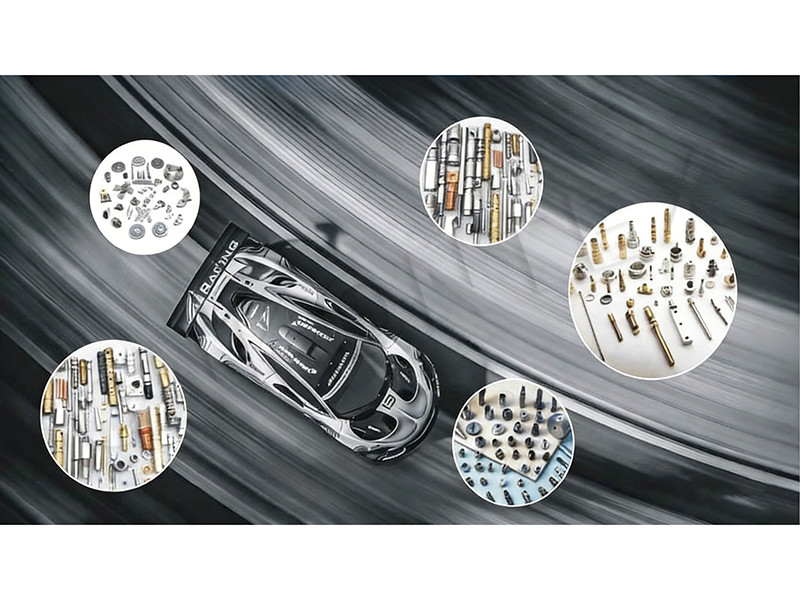
Automotive Precision Parts: Core Components Empowering Vehicle Upgrading
Release time:2026-01-31
Visits:282
Automotive precision parts are core components that determine the performance, safety and reliability of vehicles, covering powertrain, chassis, electronics, body and other key systems. Different from ordinary auto parts, they feature ultra-high dimensional accuracy, excellent mechanical properties and stable wear resistance, with dimensional tolerances usually controlled within ±0.005mm and surface roughness up to Ra0.05μm. As the automotive industry moves towards electrification, intelligence and lightweight, the demand for high-precision, high-performance automotive precision parts is growing rapidly, becoming a key support for the upgrading of the global automotive industry.
The types of automotive precision parts are diverse, each undertaking an irreplaceable functional role. In the powertrain system, precision parts such as engine crankshafts, camshafts, piston pins and transmission gears are the core of power transmission. These parts need to withstand high temperature, high pressure and long-term fatigue wear, so they are usually made of high-strength alloy steel and processed by precision forging and grinding technology to ensure stable power output and long service life. For new energy vehicles, precision parts such as motor rotors, stators, battery connecting pieces and inverter cores are crucial, requiring higher precision and electrical conductivity to improve energy conversion efficiency and extend battery life.
In the chassis system, precision parts including brake calipers, steering gears, suspension ball pins and wheel hubs directly affect vehicle handling stability and driving safety. For example, precision brake caliper parts ensure uniform stress during braking, avoiding deviation and improving braking accuracy; high-precision steering gear components realize sensitive and accurate steering response, enhancing driving comfort and safety. In the electronic system, precision connectors, sensors, chip carriers and other parts are the "nerve endings" of the vehicle, ensuring stable signal transmission between various electronic components, which is the basis for the normal operation of intelligent functions such as automatic driving, adaptive cruise and intelligent navigation.
The production of automotive precision parts adheres to strict technical standards and processes, integrating advanced manufacturing technologies. Raw material selection focuses on high-strength, wear-resistant and corrosion-resistant materials, such as alloy steel, aluminum alloy, titanium alloy and engineering plastics, which are selected according to the use environment and functional requirements of the parts. The core processing technologies include precision forging, five-axis CNC machining, precision grinding, laser cutting and 3D printing. Among them, five-axis CNC machining realizes multi-angle and multi-surface integrated processing in one clamping, greatly reducing clamping errors and improving processing efficiency and precision. Precision grinding further optimizes the surface quality and dimensional accuracy of parts, ensuring their assembly performance and service life.
Quality control is the key link in the production of automotive precision parts, running through the entire process from raw material procurement to finished product delivery. High-precision testing equipment such as coordinate measuring machines, optical projectors and laser measuring instruments are used to detect the dimensional accuracy, geometric tolerance and surface quality of parts to ensure that each parameter meets the design requirements. In addition, fatigue testing, wear testing, corrosion testing and other performance tests are carried out to verify the reliability and durability of parts under extreme working conditions. At present, mainstream manufacturers have passed ISO/TS 16949 quality management system certification, establishing a complete quality traceability system to ensure the consistency and stability of product quality.
Driven by the trends of electrification, intelligence and lightweight, the global automotive precision parts industry is developing rapidly. The market size is expected to exceed 800 billion US dollars by 2030, with the Asia-Pacific region as the fastest-growing market. While facing opportunities, the industry also faces challenges such as high technical barriers, intense market competition and rising raw material prices. In the future, automotive precision parts will develop towards higher precision, integration, intelligence and greenization. With the continuous innovation of manufacturing technology and the improvement of quality standards, they will further promote the development of the automotive industry in a more efficient, energy-saving and safe direction, empowering the transformation and upgrading of the global automotive industry.