BNC Connector Detailed Explanation: Uses, Types, And Key Knowledge Points For Usage
Release time:2026-05-11
Visits:318
In the field of radio frequency (RF) signal transmission, the
BNC connector is a long-lasting classic interface—its presence is almost ubiquitous in scenarios requiring stable RF signal transmission, from analog video cables to amateur radio antennas, from electronic test equipment to avionics systems. As the terminator of coaxial cables, what makes BNC still in use after decades without being? Today, we will take you to thoroughly understand the core logic of this interface.
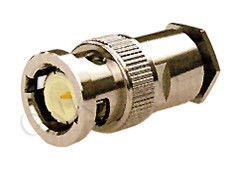
I. What is a BNC Connector? The Design Code Hidden in the Name
The full name of BNC is Bayonet Neill-Concelman, which contains two key pieces of information:
- Bayonet: Its connection method is twist-to-lock—after inserting the plug into the socket, twist it 1/4 turn to lock via the bayonet, no need to screw in bolts, making it quick and secure;
- Neill-Concelman: These are the surnames of the two inventors (Paul Neill and Carl Concelman), paying tribute to their contributions to RF interface design.
In simple terms, BNC is a bayonet-locked coaxial cable RF interface, whose core function is to enable coaxial cables to stably transmit analog or digital RF signals.
II. The Two Main Types of BNC: 50 Ohms vs. 75 Ohms, Choosing the Right One Matters
The most core distinction of BNC lies in impedance (the resistance during signal transmission), divided into 50-ohm and 75-ohm versions, which directly determine its applicable scenarios:
1. 50-Ohm BNC: The First Choice for Data and RF Transmission
50 ohms is the standard impedance for RF and data transmission, suitable for:
- Antenna connections in amateur radio equipment;
- Signal transmission in electronic test instruments (such as oscilloscopes, signal generators);
- Signal links in industrial RF equipment.
Its advantage is minimal signal loss when impedance is matched—when a 50-ohm BNC is paired with a 50-ohm coaxial cable, the probability of signal errors is almost negligible.
2. 75-Ohm BNC: The Exclusive for Video and Communication
75 ohms is the standard impedance for video and low-frequency communication, mainly used in:
- Analog/digital video signal transmission (such as video cables for old surveillance cameras, TV signal cables);
- DS3 signal connections in telephone company central offices (a type of high-speed communication link);
- Very high frequency (VHF) applications (such as FM broadcasting, aviation communication).
The 75-ohm design focuses more on low-loss transmission of video signals, which can effectively reduce screen flickering or trailing.
III. The Red Line for Using BNC: Do Not Misplug, Impedance Matching is Key
Many people mistakenly believe that if it can be plugged in, it can be used, but the core taboo of BNC is impedance mismatch:
- Although 50-ohm and 75-ohm BNCs can be physically inserted into each other, the signal will bounce back (a professional term called reflection)—for example, using a 50-ohm plug on a 75-ohm socket will cause video to flicker and RF signals to have noise;
- More dangerously, forcefully inserting a 50-ohm plug into a 75-ohm socket may damage the equipment—the pins of 75-ohm sockets are thinner, while those of 50-ohm plugs are thicker, and forced insertion will bend or even break the contact points of the socket.
Remember: When choosing BNC, first look at the scenario, then match the impedance—75 ohms for video, 50 ohms for RF/data, and you'll never go wrong.
IV. BNC's Close Relatives: Don't Confuse These Interfaces
BNC is not fighting alone; it has several common partners with similar functions but different scenarios:
1. TNC Connector: The Upgraded Version for Microwave Bands
TNC stands for Threaded Neill-Concelman, replacing BNC's bayonet with threads.
Its advantage is better performance in microwave bands—such as high-frequency scenarios like satellite communication and radar systems, where threaded connections are more secure than bayonet and have less signal loss, but the connection speed is slower than BNC (requires screwing).
2. Triaxial BNC: The Shielded Version for Sensitive Measurements
Triaxial BNC (also called TRB) has an additional shielding layer compared to ordinary BNC, which can effectively resist external electromagnetic interference. It was used in sensitive electronic measurement systems (such as high-precision laboratory instruments). However, it has gradually been replaced by smaller connectors and is now rarely seen.
3. MHV/SHV: The Safe Version for High-Voltage Scenarios
In high-voltage applications (such as high-voltage power supplies, particle accelerators), ordinary BNC is prone to electric shock, so there are two safe alternatives:
- MHV: Can be forcefully inserted into BNC but has no anti-misinsertion design, which is dangerous;
- SHV: Specially designed with a foolproof structure, incompatible with ordinary BNC, completely avoiding misoperation and being safer.
V. Those Different BNCs: Regional and Special Versions
1. The SR Series in the Former Soviet Union: The Imitation Converting Imperial to Metric
In the former Soviet Union, BNC was copied as SR-50 (corresponding to 50 ohms) and SR-75 (corresponding to 75 ohms). Since the former Soviet Union used metric units while BNC was designed in imperial, the dimensions of the SR series are slightly different from the original, but they can be forcefully plugged in—however, it is better to choose the original BNC for more reliable compatibility.
2. Twinaxial BNC: The Dual Lane for Differential Signals
Twinaxial BNC (also called dual-plug BNC) looks the same as ordinary BNC but has two independent contact points inside, specially designed to transmit differential pair signals (a type of anti-interference high-speed signal). Note: It is not compatible with ordinary BNC, so don't buy the wrong one!
VI. Summary: 3 Keys to Using BNC Correctly
Since its invention, the BNC connector has become an evergreen in the field of RF transmission with its advantages of simplicity, reliability, and ease of operation. The core principles for using it correctly are only 3:
1. First look at the scenario: 75 ohms for video, 50 ohms for RF/data;
2. Must match impedance: Do not misplug interfaces with different impedances, as it will damage the equipment;
3. Distinguish versions: Special versions such as twinaxial and SR series are not compatible with ordinary BNC, so confirm clearly before purchasing.
Whether you are a novice or an experienced engineer, mastering these 3 points will allow you to use BNC as steady as a rock—after all, the vitality of a classic interface never relies on complexity, but on doing simple things to the extreme.