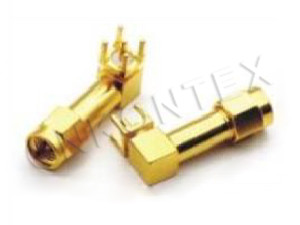
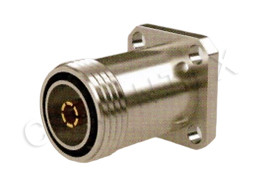
What Is the N-Type Connector and Where Is It Used?
The N-Type connector is a threaded, 50 Ω (or 75 Ω) coaxial RF connector with a hex nut coupling, a frequency range typically rated to 11 GHz (18 GHz for precision versions), and a history dating back to the 1940s as a weatherproof medium-power interface. N-Type was developed in 1942 by Paul Neill at Bell Labs and became the standard military RF connector for radar, instrumentation, and base-station feeders for decades.
Typical N-Type applications:
Cellular base-station feeders and antenna jumpers.
Broadcast (FM, TV, satellite up-link) transmitters.
Radar and avionics (legacy systems).
Test and measurement (lower-frequency network analyzers).
RF power amplifiers and combiners.
Industrial heating and scientific (RF generators).
The N-Type's weatherproof threaded coupling, robust mechanical construction, and moderate frequency range have made it a long-lived workhorse in medium-power RF infrastructure.
What Is the 7/16 DIN (L29) Connector and Where Is It Used?
The
7/16 DIN (L29) connector is a threaded, 50 Ω coaxial RF connector with a hex nut coupling (M29 × 1.5), a frequency range up to 7.5 GHz, and a power handling far exceeding N-Type (up to ~1500 W CW at 1 GHz). 7/16 DIN was standardized in Germany as DIN 47223 / IEC 61169-4 and is the dominant macro-cell base-station jumper interface worldwide.
Typical 7/16 DIN (L29) applications:
4G LTE and 5G macro-cell base-station feeders and jumpers.
Distributed antenna systems (DAS) and in-building wireless (IBW).
High-power broadcast transmitters (FM, DVB-T, DAB).
RF combiners and filters in cellular infrastructure.
Microwave links (lower-band, < 6 GHz).
The "7/16" in the name refers to the 7 mm inner conductor and 16 mm outer diameter of the dielectric; "L29" refers to the M29 × 1.5 threaded coupling nut. 7/16 DIN (L29) is the dominant base-station feeder interface globally because it provides a combination of high power handling, very low PIM (typically −155 to −168 dBc @ 2 × 43 dBm), and rugged weatherproof mechanical coupling.
How Do N-Type and 7/16 DIN Compare?
N-Type and 7/16 DIN (L29) overlap significantly in the 1–6 GHz range but differ in power handling, frequency ceiling, and PIM performance. The decision depends on power level, frequency, and infrastructure standard.
|
Specification |
N-Type (50 Ω) |
7/16 DIN (L29) |
|
Characteristic impedance |
50 Ω (75 Ω variant available) |
50 Ω |
|
Frequency range |
DC – 11 GHz (precision: 18 GHz) |
DC – 7.5 GHz |
|
Power handling (CW @ 1 GHz) |
~300 W |
~1500 W |
|
Power handling (CW @ 6 GHz) |
~80 W |
~600 W |
|
PIM (typ., 2 × 43 dBm) |
−115 to −130 dBc |
−155 to −168 dBc |
|
Coupling nut thread |
5/8"-24 UNEF |
M29 × 1.5 |
|
Body OD (typical plug) |
~20 mm |
~38 mm |
|
Mating cycles |
≥ 500 |
≥ 500 |
|
Weatherproofing |
IP67 (with gaskets) |
IP67 (with gaskets) |
|
Typical cost (relative) |
1× |
3–5× |
7/16 DIN (L29) is the larger, heavier, more expensive connector with substantially higher power and better PIM. N-Type is more compact, lower cost, and extends to higher frequencies.
When Should You Choose N-Type?
N-Type is the right choice for applications in the DC–11 GHz range that need a rugged, threaded, weatherproof connector with moderate power handling (up to ~300 W CW), at lower cost than 7/16 DIN. N-Type is the default for test equipment, lower-power base-station feeders, and broadcast where the power does not exceed N-Type's limits.
Decision factors for N-Type:
Frequency. Up to 11 GHz (precision N-Type to 18 GHz).
Power. Up to ~300 W CW at 1 GHz; ~80 W at 6 GHz.
PIM. Acceptable for non-LTE applications (−115 to −130 dBc typ.).
Mechanical. 5/8"-24 threaded coupling; smaller than 7/16 DIN.
Cost. Lower than 7/16 DIN (typically 1/3 to 1/5 the cost).
Standards. MIL-STD-348, IEC 61169-16.
N-Type is the standard choice for 75 Ω video (with the 75 Ω variant), for legacy instrumentation, and for moderate-power cellular small-cell and in-building applications.
When Should You Choose 7/16 DIN (L29)?
7/16 DIN (L29) is the right choice for macro-cell base-station feeders, DAS, and high-power broadcast where very low PIM (≤ −155 dBc), high power (up to 1500 W CW at 1 GHz), and rugged mechanical coupling are mandatory. 7/16 DIN is the global standard for 4G LTE and 5G macro-cell infrastructure.
Decision factors for 7/16 DIN (L29):
Frequency. Up to 7.5 GHz (covers all sub-6 GHz cellular bands).
Power. Up to ~1500 W CW at 1 GHz; ~600 W at 6 GHz.
PIM. Mandatory ≤ −155 dBc (often specified ≤ −160 dBc) for LTE/5G.
Mechanical. M29 × 1.5 threaded coupling; weatherproof IP67 with proper torquing.
Cost. Higher than N-Type (3–5× per interface), but justified by PIM/power.
For 4G LTE and 5G base stations where PIM directly affects downlink/uplink SINR and capacity, 7/16 DIN is essentially mandatory. Kontex's 7/16 DIN (L29) Series provides the standard interface with low-PIM versions.
What Are the Common Mounting Styles?
N-Type and 7/16 DIN connectors are available in cable-mount, panel-mount (bulkhead), and PCB-mount styles, with bulkhead feed-through being the most common in base-station enclosures and combiners.
|
Mounting style |
N-Type |
7/16 DIN (L29) |
Typical use |
|
Cable straight plug |
Yes |
Yes |
Cable-end termination |
|
Cable right-angle plug |
Yes |
Yes |
Tight-space cable routing |
|
Cable bulkhead jack |
Yes |
Yes |
Panel feed-through |
|
Panel-mount 4-hole flange jack |
Yes |
Yes |
Equipment chassis |
|
PCB vertical / right-angle jack |
Yes |
Less common |
Component integration |
|
In-line adapter (N-to-N, 7/16-to-7/16) |
Yes |
Yes |
Cable extensions |
|
Inter-series adapter (N-to-7/16, etc.) |
Yes |
Yes |
System integration |
Bulkhead jacks with O-ring sealing provide IP67 weatherproofing when properly torqued. Kontex's N-Type and 7/16 DIN (L29) series offer all standard mounting styles.
What Materials and Platings Are Used?
Both N-Type and 7/16 DIN connectors use brass or stainless-steel bodies with beryllium-copper center contacts and PTFE insulators, with silver or tri-metal plating (Cu-Sn-Zn) for low-PIM low-loss operation. Low-PIM versions require non-magnetic plating (silver or tri-metal, never nickel).
|
Component |
Standard material |
Plating (low-PIM) |
|
Body |
Brass (C36000) |
Silver or tri-metal (Cu-Sn-Zn) |
|
Center contact |
Beryllium copper (C17300) |
Silver or gold over Cu |
|
Outer contact |
Brass |
Silver or tri-metal |
|
Insulator |
PTFE |
n/a |
|
Coupling nut |
Brass |
Silver or tri-metal |
|
Gasket / O-ring |
Silicone rubber |
n/a |
Nickel plating is ferromagnetic and is a primary source of PIM. For low-PIM 7/16 DIN (mandatory for LTE/5G), silver or tri-metal plating is required throughout the signal path.
What Cable Groups Are Compatible?
N-Type and 7/16 DIN (L29) connectors are designed for medium-to-large coaxial cables in the 0.250" to 0.500" OD range, with 7/16 DIN typically terminating larger, lower-loss cables (1/2", 7/8", 1-1/4", 1-5/8") for base-station feeder applications.
|
Cable |
OD (in) |
Impedance |
Frequency limit |
Typical use |
|
RG-213 |
0.405 |
50 Ω |
5 GHz |
General-purpose, N-Type |
|
RG-214 |
0.425 |
50 Ω |
6 GHz |
Double-shielded |
|
LMR-400 |
0.405 |
50 Ω |
6 GHz |
Low-loss flexible |
|
LMR-600 |
0.590 |
50 Ω |
6 GHz |
Low-loss, higher power |
|
1/2" annular |
0.500 |
50 Ω |
6 GHz |
Base-station feeder, 7/16 DIN |
|
7/8" annular |
0.875 |
50 Ω |
5 GHz |
Macro-cell feeder, 7/16 DIN |
|
1-1/4" annular |
1.250 |
50 Ω |
4 GHz |
High-power feeder, 7/16 DIN |
|
1-5/8" annular |
1.625 |
50 Ω |
3.5 GHz |
Highest-power feeder, 7/16 DIN |
For 7/16 DIN base-station feeders, Kontex's RF Cable Assembly Series provides factory-terminated jumpers with documented PIM performance.
How Is Torque Applied?
Both N-Type and 7/16 DIN connectors require calibrated torque wrenches: N-Type at 15 in-lbs (1.7 N·m) and 7/16 DIN at 88 in-lbs (10 N·m) for the coupling nut, with the wrench applied to the body of the mating connector to prevent rotation. Over-torque damages the contact; under-torque causes poor PIM and weatherproofing failure.
|
Connector |
Coupling torque |
Tooling |
|
N-Type |
15 in-lbs (1.7 N·m) |
Calibrated torque wrench, 5/8" or 3/4" |
|
7/16 DIN (L29) |
88 in-lbs (10 N·m) |
Calibrated torque wrench, 32 mm |
|
N-Type (75 Ω) |
15 in-lbs (1.7 N·m) |
Same as 50 Ω N-Type |
For 7/16 DIN, under-torque is a common cause of failed PIM test. Always use a calibrated torque wrench and follow the manufacturer's torque specification.
What About Intermodulation (PIM)?
PIM (Passive Intermodulation) is the generation of unwanted intermodulation products at the connector interface due to nonlinearities in metal-to-metal contact, ferromagnetic materials, or loose mechanical coupling. PIM is critical for LTE/5G base stations because intermodulation products fall directly into the receive band and degrade SINR.
|
PIM source |
Mitigation |
|
Nickel plating (ferromagnetic) |
Use silver or tri-metal plating |
|
Loose coupling |
Use torque wrench to specification |
|
Contaminated contact surface |
Clean with isopropyl alcohol before mating |
|
Mixed materials in signal path |
Use matched material set throughout |
|
Damaged contact surface |
Replace connector |
7/16 DIN (L29) connectors for LTE/5G typically specify PIM ≤ −155 dBc @ 2 × 43 dBm (sometimes ≤ −160 dBc). N-Type low-PIM versions specify ≤ −130 dBc.
How Do They Compare to Smaller Connectors?
Both N-Type and 7/16 DIN are larger and more rugged than SMA or BNC, but at the cost of size and (for 7/16 DIN) cost. SMA dominates the < 18 GHz microwave test and measurement space; N-Type and 7/16 DIN dominate the high-power cellular and broadcast space.
|
Connector |
Frequency |
Coupling |
Body size |
Power (CW @ 1 GHz) |
|
SMA |
18 GHz |
Threaded |
Small |
~200 W |
|
N-Type |
11 GHz |
Threaded |
Medium |
~300 W |
|
7/16 DIN (L29) |
7.5 GHz |
Threaded |
Very large |
~1500 W |
|
TNC |
11 GHz |
Threaded |
Medium |
~200 W |
For applications requiring both high frequency and high power (above 6 GHz with high CW), waveguide is preferred over coaxial.
Frequently Asked Questions
Q: Can N-Type and 7/16 DIN be mated with an adapter?
A: Yes. N-to-7/16 inter-series adapters are widely available and are commonly used to connect smaller instrumentation to base-station feeders. Note that the adapter adds an interface and slightly degrades PIM and VSWR.
Q: What is the difference between 7/16 DIN and L29?
A: There is no difference. "7/16 DIN" is the IEC common name (referring to the 7 mm / 16 mm geometry); "L29" is the older DIN designation (referring to the M29 × 1.5 coupling thread). Kontex uses both names: the 7/16 DIN (L29) Series covers both conventions.
Q: Can 7/16 DIN be used above 7.5 GHz?
A: 7/16 DIN is specified to 7.5 GHz but will physically operate to higher frequencies with degraded VSWR. For applications above 7.5 GHz, use N-Type (to 11 GHz), SMA (to 18 GHz), or 2.92 mm (to 40 GHz).
Q: Why does 7/16 DIN have such low PIM?
A: 7/16 DIN has a large coupling nut with high contact pressure at the outer interface, large-diameter silver-plated contacts, and is typically supplied in non-ferrous (silver or tri-metal) plating. The combination yields very low PIM.
Q: What torque is required for 7/16 DIN?
A: 88 in-lbs (10 N·m). Always use a calibrated torque wrench. Under-torque is a common cause of failed PIM tests.
Q: Is N-Type available in 75 Ω?
A: Yes, the 75 Ω N-Type variant is widely used for video, cable TV, and broadcast. The 75 Ω version has a slightly different center pin geometry and is not mateable with 50 Ω N-Type.
Q: What cable is best for 7/16 DIN at 6 GHz?
A: For 6 GHz with low loss and high power, use 1/2" or 7/8" annular corrugated cable with factory-terminated 7/16 DIN connectors. Kontex's RF Cable Assembly Series provides pre-terminated jumpers with 1/2", 7/8", and larger cables.
Q: Does Kontex offer low-PIM 7/16 DIN?
A: Yes. Kontex's 7/16 DIN (L29) Series includes low-PIM versions with documented ≤ −155 dBc @ 2 × 43 dBm performance, suitable for 4G LTE and 5G macro-cell applications.
Q: Can 7/16 DIN be used outdoors?
A: Yes. 7/16 DIN connectors with proper sealing (silicone O-rings on bulkhead jacks, heat-shrink boots on cable terminations) are rated IP67 for outdoor deployment on macro-cell towers.
Conclusion
N-Type and 7/16 DIN (L29) are the two dominant threaded RF interfaces for medium- to high-power cellular, broadcast, and instrumentation applications, with the choice driven by power level, frequency range, PIM requirements, and cost. N-Type (up to 11 GHz, ~300 W CW) is the default for moderate-power and lower-cost applications; 7/16 DIN (L29) (up to 7.5 GHz, ~1500 W CW) is the mandatory choice for macro-cell LTE/5G base stations where low PIM is critical. Kontex's N-Type Series and 7/16 DIN (L29) Series cover the full range with matching RF Cable Assembly Series for pre-terminated jumpers. For product range, certifications, and export documentation, consult the Field Application and About pages.