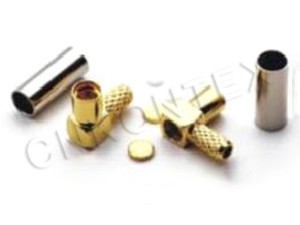
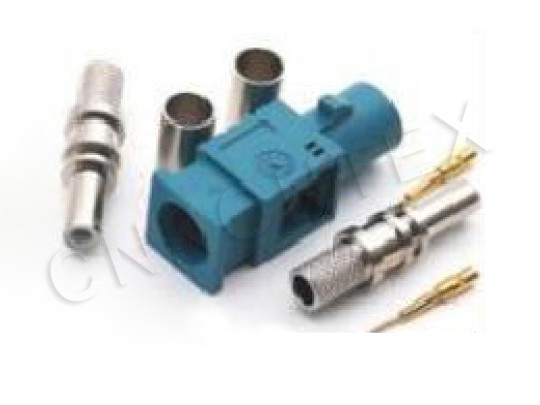
What Is a FAKRA Connector and Where Is It Used?
FAKRA is a family of SMB-style coaxial RF connectors housed in a plastic shell with color-coded mechanical keying, designed for automotive applications up to 6 GHz. FAKRA was developed by a consortium of German automotive OEMs (Audi, BMW, Daimler, Porsche, Volkswagen) under the Fachkreis Automobil standardization group, and is now governed by the USCAR (United States Council for Automotive Research) and ISO 20860 standards.
Typical FAKRA applications:
AM/FM radio antenna (roof or shark-fin).
GPS navigation antenna.
Satellite radio (SDARS, SiriusXM) antenna.
Cellular telematics (4G LTE, 5G).
V2X (Vehicle-to-Everything, including C-V2X and DSRC).
ADAS radar data distribution (legacy; current ADAS uses coax or Ethernet).
Infotainment and telematics control unit (TCU) connectivity.
Tire pressure monitoring system (TPMS).
Keyless entry / passive start (low frequency, but uses FAKRA housings).
The combination of standardized mechanical keying (preventing mis-mating), SMB-style inner contact (well-proven RF performance), and plastic housing (lightweight, low cost) has made FAKRA the dominant automotive RF interface.
What Is the FAKRA Mechanical Key System?
FAKRA connectors use 14 standardized mechanical key codes (A through N, plus Z) that physically prevent mis-mating between different RF functions, with each key assigned a specific application and a standard color. The key codes are defined in the USCAR / ISO 20860 standards.
|
Code |
Color |
Typical application |
|
A |
Black |
Radio without phantom supply |
|
B |
White |
Radio with phantom supply |
|
C |
Blue |
GPS |
|
D |
Green |
GSM (cellular) |
|
E |
Brown |
TV |
|
F |
Beige |
SDARS (satellite radio) |
|
G |
Gray |
WLAN |
|
H |
Violet |
Bluetooth |
|
I |
Beige |
Keyless entry (LF) |
|
K |
Pink |
Keyless entry / passive start |
|
L |
Light blue |
TPMS |
|
M |
Yellow |
DSRC / V2X |
|
N |
Light green |
C-V2X / 5G |
|
Z |
(none) |
Custom / undefined |
The mechanical keying system ensures that a GPS antenna cable cannot be inadvertently connected to a cellular antenna port, and vice versa. This is critical for vehicle assembly because mis-mating would cause functional failures that are difficult to diagnose in the field.
What Are the Electrical Specifications?
FAKRA connectors follow the SMB inner contact electrical interface, with characteristic impedance of 50 Ω, frequency range DC – 6 GHz, and VSWR ≤ 1.40 typical at 6 GHz. The plastic housing does not affect electrical performance; the inner contact is standard SMB.
|
Specification |
FAKRA (50 Ω) |
FAKRA (75 Ω) |
|
Characteristic impedance |
50 Ω |
75 Ω |
|
Frequency range |
DC – 6 GHz |
DC – 3 GHz |
|
VSWR (DC – 3 GHz) |
≤ 1.30 |
≤ 1.40 |
|
VSWR (3 – 6 GHz) |
≤ 1.40 |
n/a |
|
Insertion loss (DC – 6 GHz) |
≤ 0.30 dB |
≤ 0.50 dB |
|
Mating cycles |
≥ 50 |
≥ 50 |
|
Operating temperature |
−40 °C to +105 °C |
−40 °C to +105 °C |
|
Return loss (typ. 2.4 GHz) |
≥ 18 dB |
≥ 15 dB |
The 50 Ω variant is dominant for GPS, cellular, V2X, and most modern RF applications. The 75 Ω variant is used for legacy AM/FM radio, TV antenna, and some SDARS applications.
What Are the Mechanical Features?
FAKRA connectors feature a plastic housing with a snap-on latch, a color-coded mechanical key, an SMB inner contact, and a cable strain relief, designed for hand-mating during vehicle assembly and for vibration resistance during vehicle operation.
|
Mechanical feature |
Function |
|
Plastic housing |
Lightweight, color-coded keying, low cost |
|
Snap-on latch |
Audible click confirms mating; tool-free |
|
Mechanical key (14 codes) |
Prevents mis-mating |
|
SMB inner contact |
Standard RF interface |
|
Strain relief |
Resists cable pull-out during vehicle vibration |
|
Sealed version (FAKRA II) |
IP67/IP6K9K for under-hood or exposed locations |
|
PCB-mount version |
Vertical or right-angle for module integration |
FAKRA II (sealed) is used for outdoor or under-hood applications such as shark-fin roof antennas and external V2X antennas. Standard FAKRA (unsealed) is used for in-cabin applications.
What Are the Cable Compatibility Groups?
FAKRA connectors are designed for a wide range of automotive coaxial cables, with the specific cable group depending on the application (signal integrity, power handling, and flexibility). Common cable groups include RG-174, RG-178, RG-316, RTK 031, RTK 047, and various automotive-specific cable types.
|
Cable |
OD (mm) |
Impedance |
Frequency limit |
Typical use |
|
RG-174 |
2.8 |
50 Ω |
3 GHz |
Low-frequency signal |
|
RG-316 |
2.6 |
50 Ω |
3 GHz |
Low-frequency, flexible |
|
RG-178 |
1.8 |
50 Ω |
3 GHz |
Very thin, tight routing |
|
RTK 031 |
3.1 |
50 Ω |
6 GHz |
Standard automotive, 6 GHz capable |
|
RTK 047 |
4.7 |
50 Ω |
6 GHz |
Lower loss, longer runs |
|
RTK 058 |
5.8 |
50 Ω |
6 GHz |
Lowest loss automotive |
|
DA 179 (1.5C) |
2.7 |
50 Ω |
6 GHz |
Japanese standard automotive |
|
RTK 086 (low loss) |
8.6 |
50 Ω |
6 GHz |
Long feeder runs |
For modern V2X, 5G, and high-bandwidth telematics, RTK 031 or RTK 047 are standard. For 5G FR1 in-vehicle connectivity, RTK 047 or higher is recommended.
When Should You Choose FAKRA?
FAKRA is the right choice for any automotive RF application up to 6 GHz that requires mechanical keying to prevent mis-mating, with standardized cable assemblies, and with an SMB-style inner contact for proven RF performance. FAKRA is essentially mandatory for global automotive OEMs and Tier 1 suppliers.
Decision factors:
Application. Any automotive RF up to 6 GHz.
Mechanical keying. Required for multi-cable harnesses.
Standardization. USCAR / ISO 20860 for global supply chain.
Cost. Low (commodity, high-volume).
Environment. −40 °C to +105 °C operating, IP67 sealed versions available.
Cable. Standard automotive cable groups (RTK 031, RTK 047, etc.).
For ADAS radar (76–81 GHz), FAKRA is not used — proprietary automotive coax or waveguide is preferred. For 5G FR2 (24–40 GHz), FAKRA extends to about 6 GHz and is being supplemented by higher-frequency automotive coax (HSD, coax-based Ethernet variants).
What Are FAKRA Variants?
FAKRA has evolved into several variants including the original FAKRA (unsealed), FAKRA II (sealed IP67), FAKRA III (miniaturized), and HSD (High-Speed Data) for automotive Ethernet. Each variant addresses different requirements.
|
Variant |
Description |
Application |
|
FAKRA (original) |
Unsealed, standard |
In-cabin RF |
|
FAKRA II |
Sealed (IP67/IP6K9K), plastic housing |
Outdoor / under-hood |
|
FAKRA III |
Miniaturized, smaller key |
High-density modules |
|
HSD |
High-Speed Data, 100 Ω differential |
Automotive Ethernet (100BASE-T1, 1000BASE-T1) |
|
HSD+ |
Higher frequency variant |
5G, high-bandwidth automotive |
|
FAKRA-for-Coax |
Standard FAKRA for coax-only harnesses |
Aftermarket, replacement |
HSD (High-Speed Data) is a related but separate interface family within the automotive RF connector ecosystem, used for LVDS and Ethernet signals over coax.
What Are the Limitations?
FAKRA has four main limitations: frequency ceiling at 6 GHz (insufficient for 5G FR2 and ADAS radar), limited power handling, plastic housing that limits durability in harsh environments, and 50 mating cycle durability that may be insufficient for service. Each limitation is addressable.
|
Limitation |
Cause |
Mitigation |
|
6 GHz frequency limit |
SMB inner contact and plastic housing |
Use HSD+ or proprietary coax for > 6 GHz |
|
Power limit |
Small center pin |
Use N-Type or 7/16 DIN for high power |
|
Plastic housing durability |
Polymer aging, UV exposure |
Use sealed FAKRA II or metal-shell variants for under-hood |
|
Mating cycle limit |
Snap-on wear |
Replace as service part; use metal-shell variants for higher cycles |
For 5G FR2 and ADAS radar, the automotive industry is moving toward proprietary high-frequency coax (e.g., Huber+Suhner SUCOFLEX automotive variants) and waveguide.
How Does FAKRA Compare to Other RF Connectors?
FAKRA dominates the automotive RF space due to its mechanical keying and standardization, but is less suitable for high-frequency (> 6 GHz) or high-power applications where SMB, SMA, or N-Type are preferred. Kontex's Automotive Precision Parts page covers adjacent hardware such as chassis-mounted RF modules.
|
Connector |
Frequency |
Coupling |
Application |
|
FAKRA |
6 GHz |
Snap-on, keyed |
Automotive RF (default) |
|
SMB |
4 GHz |
Snap-on |
Industrial, automotive (un-keyed) |
|
SMA |
18 GHz |
Threaded |
Test, microwave |
|
BNC |
4 GHz |
Bayonet |
Test, video |
|
N-Type |
11 GHz |
Threaded |
High-power RF |
For test and instrumentation, FAKRA-to-SMA or FAKRA-to-BNC adapters are commonly used to allow standard test equipment to interface with FAKRA-equipped vehicle systems.
What Are Common Automotive Applications?
FAKRA connectors are used in every modern vehicle for radio, GPS, cellular, V2X, and telematics connectivity, with the number of FAKRA connectors per vehicle ranging from 4 to 12 depending on the trim level and feature content.
|
Application |
FAKRA code |
Typical vehicle location |
|
AM/FM radio |
A or B |
Roof antenna, body |
|
GPS |
C |
Roof shark-fin, dashboard |
|
SDARS (SiriusXM) |
F |
Roof shark-fin |
|
Cellular (4G LTE, 5G) |
D or N |
Roof shark-fin, TCU |
|
V2X (DSRC, C-V2X) |
M or N |
Roof, behind bumper |
|
Infotainment |
A |
Behind dashboard |
|
TCU telematics |
D |
TCU enclosure |
|
TPMS |
L |
Wheel well |
|
Keyless entry |
I or K |
Door handles, B-pillar |
Modern vehicles with 5G, V2X, and satellite connectivity may have 8–12 FAKRA connectors in a single roof shark-fin antenna module.
Frequently Asked Questions
Q: What is the difference between FAKRA and SMB?
A: SMB is the inner-contact electrical interface; FAKRA adds a plastic housing with mechanical keying and color coding. FAKRA-compatible SMB contacts can be mated directly with SMB connectors, but the FAKRA housing provides keying that SMB does not.
Q: Can I mix FAKRA connectors from different manufacturers?
A: Yes. FAKRA is an open standard (USCAR / ISO 20860), and connectors from different manufacturers are designed to be mate-compatible. Kontex's FAKRA Series is compatible with all standard FAKRA cable and connector specifications.
Q: What is the maximum frequency for FAKRA?
A: Standard FAKRA is rated to 6 GHz (some versions to 3 GHz). For applications above 6 GHz, use HSD+ (up to 6 GHz with different keying), or move to proprietary high-frequency automotive coax for 5G FR2 and ADAS radar.
Q: What is FAKRA II?
A: FAKRA II is the sealed variant with IP67/IP6K9K rating, suitable for outdoor and under-hood applications. The sealing protects against water, dust, and pressure washing. The inner contact is identical to standard FAKRA.
Q: How many mating cycles can FAKRA sustain?
A: Standard FAKRA is rated for 50 mating cycles (sufficient for assembly and service). For higher cycle counts, metal-shell variants or HSD variants offer 100+ cycles.
Q: What is the difference between FAKRA and HSD?
A: FAKRA is for coaxial RF signals (50 Ω, up to 6 GHz). HSD (High-Speed Data) is for differential 100 Ω signals (LVDS, automotive Ethernet) using a different pin configuration in a similar plastic housing.
Q: Can I use FAKRA for 5G?
A: For 5G FR1 (< 6 GHz), standard FAKRA is suitable with RTK 047 or higher cable. For 5G FR2 (24–40 GHz), FAKRA is not sufficient — use proprietary high-frequency automotive coax or waveguide.
Q: Does Kontex offer FAKRA cable assemblies?
A: Yes. Kontex's RF Cable Assembly Series includes FAKRA-terminated cable harnesses for automotive applications, with all standardized cable groups and key codes.
Q: What is the standard FAKRA color for GPS?
A: Blue (code C). The color coding is defined in the USCAR / ISO 20860 standards and is consistent across all manufacturers.
Conclusion
FAKRA is the dominant RF connector for automotive applications, providing a standardized, mechanically-keyed, color-coded, snap-on interface that prevents mis-mating in complex vehicle wiring harnesses. Kontex's FAKRA Series covers the full connector and cable family, complemented by the Automotive Precision Parts page for adjacent chassis and interior hardware and the RF Cable Assembly Series for pre-terminated cable harnesses. For product range, certifications, and automotive-specific engineering support, consult the Field Application and About pages.