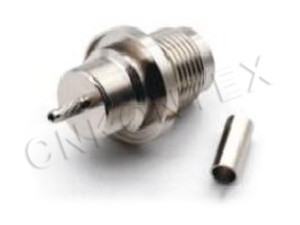
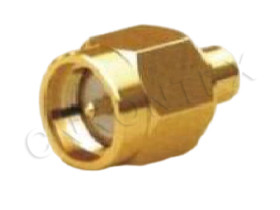
SSMA Connectors: Choosing Inside A 30 GHz Sub-Miniature Series
Release time:2026-11-13
Visits:25
Between the familiar SMA and the instrument-grade 2.92 mm interface there is a narrow band of applications where nothing else quite fits: phased array elements, compact radar front ends, satellite up- and down-converters, high-density test fixtures.
SSMA connectors were developed for exactly that space. They keep the threaded coupling engineers already trust and shrink the body until it fits where an SMA cannot. The result is a series that looks simple in a catalogue and demands some care in selection.
What the 10-36UNS Thread Actually Buys You
SSMA uses a 10-36UNS thread, which is a smaller diameter than the SMA's 1/4-36UNS. The change is not cosmetic. A smaller coupling nut means a smaller body, a shorter dielectric path, and a lower profile on a densely packed board or a crowded bulkhead.
Smaller Than SMA, Same Idea
The interface is a scaled-down threaded coaxial pair: a centre pin, a PTFE dielectric, an outer body with a coupling nut, and a mating reference plane defined by the thread and the shoulder. Everything that makes an SMA reliable applies here — full thread engagement, a clean mating face, controlled torque — with less metal around it to absorb abuse.
Where the Scale Factor Hurts
The penalty for the smaller body is mechanical fragility at the cable end. An SSMA terminated to a 2.5 mm cable has very little leverage to resist a side load, so a harness that is pulled tight around a chassis corner will damage the connector before it damages the cable. Plan a support clamp within 40 mm of the connector on any cable run that leaves a chassis.
The Electrical Envelope
KONTEX publishes the following for the SSMA series. These are series limits; individual part numbers can be better, and no part number is better than its termination.
|
Parameter |
Value |
|
Characteristic impedance |
50 Ω |
|
Frequency range |
DC – 30 GHz |
|
VSWR |
≤ 1.07 + 0.01 F (GHz) |
|
Insulation resistance |
≥ 1000 MΩ |
|
Dielectric withstanding voltage |
750 V |
|
Contact resistance, inner conductor |
≤ 0.006 Ω |
|
Contact resistance, outer conductor |
≤ 0.0025 Ω |
|
Durability |
500 mating cycles |
|
Operating temperature |
−55 °C to +155 °C |
VSWR That Scales With Frequency
The formula 1.07 + 0.01 F is worth reading carefully. At 1 GHz it allows 1.08; at 30 GHz it allows 1.37. That is not a manufacturer being generous at the top of the band — it is an honest statement about how a real interface behaves when its electrical length becomes a significant fraction of a wavelength. When you compare
SSMA connectors from different suppliers, compare the frequency at which the quoted VSWR is specified. A 1.10 figure at 18 GHz and a 1.10 figure at 30 GHz are not the same product.
The Temperature Range Matters More Than It Looks
A −55 °C to +155 °C range is wider than most commercial RF work needs, and it is one of the reasons the series appears in avionics and outdoor radio heads. Thermal cycling moves the dielectric and the plating, and a connector that is marginal at 25 °C can open up at 120 °C. If the assembly is going to be cycled, qualify it cycled.
Mount Styles Across the Range
The KTX SSMA series is organised by how the part attaches, which is also how most designers search for it.
|
Part |
Style |
|
KTX SSMA-JB2 |
Cable connector |
|
KTX SSMA-J2 |
Cable connector |
|
KTX SSMA-JW3 |
Right-angle cable connector |
|
KTX SSMA-JWB2 |
Right-angle cable connector |
|
KTX SSMA-KFB2 |
Flange mount |
|
KTX SSMA-KFD1 |
Flange mount |
|
KTX SSMA-KFD4 |
Flange mount |
|
KTX SSMA-KHD |
Bulkhead / panel mount |
Cable Versions
Straight and right-angle cable
connectors cover the two geometries that appear in real hardware: a straight launch where the cable leaves perpendicular to the panel, and a right angle where it has to turn inside a shallow enclosure. Right-angle versions save height and cost a little return loss, because the bend is an unavoidable discontinuity. Budget for it: at 26 GHz a right-angle SSMA can add a VSWR contribution that a straight part does not.
Flange and Panel Versions
Flange parts bolt to a housing wall and give a defined reference plane with four screws, which is the most repeatable way to mount a 30 GHz interface. Bulkhead versions pass through a panel and present a mating face on both sides. In both cases the panel cutout and screw torque matter as much as the connector: an unevenly torqued flange tilts the interface, and a tilted interface at 30 GHz is a reflection.
SSMA, SMA or 2.92 mm
The three interfaces overlap enough that the choice is often made on habit. It should be made on three numbers.
|
Interface |
Usable frequency |
Coupling |
Typical role |
|
SMA |
DC – 18 GHz |
1/4-36UNS thread |
General purpose, cable and bulkhead |
|
SSMA |
DC – 30 GHz |
10-36UNS thread |
Compact high-frequency modules, arrays |
|
2.92 mm |
DC – 40 GHz |
Precision air-dielectric |
Instrumentation, calibration, lab |
An SMA is the right default below 18 GHz: cheap, everywhere, forgiving. An SSMA becomes interesting when the body has to be smaller or the band has to reach 26 to 30 GHz in a production unit rather than a lab bench. A 2.92 mm is the instrument answer, and it is usually the wrong answer for a cost-sensitive product because the precision that buys 40 GHz also buys a fragile, expensive interface.
Assembly Details That Decide Yield
Cable Preparation
Most SSMA field failures start with the strip. The dielectric must be cut square, the braid must not be nicked, and the centre pin must seat at the correct depth before crimping or soldering. At 30 GHz, 0.2 mm of pin recession is a measurable reflection. Use a strip tool with a fixed blade rather than a knife, and check the first five assemblies on a VSWR sweep before running the batch.
Torque and Support
The coupling nut is small, so the temptation is to tighten by feel. That is where the series gets damaged: over-torque distorts the body, under-torque leaves the reference planes apart. Use a small torque wrench set to the value the supplier specifies, and treat the nut as a precision part rather than a fastener. Support the cable independently of the connector so that vibration reaches the clamp, not the thread.
Buying SSMA Connectors Without Surprises
Three questions separate a good SSMA supplier from a catalogue listing. Ask for the frequency at which the VSWR limit is guaranteed, not just the limit itself. Ask for the interface dimensions and the recommended torque, because a 30 GHz part without a drawing cannot be designed in. Ask whether the plating is specified, since contact resistance of 0.006 Ω on the inner conductor depends on it.
KONTEX manufactures the SSMA series — cable, right-angle, flange and bulkhead versions — at its Zhenjiang facility in Jiangsu, alongside the SMA, SMB, SMC and QMA ranges. For a design that has to cross 18 GHz without moving to an instrument interface, that combination of a small body and a published specification is the practical starting point.