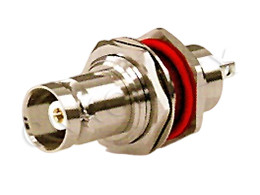
Detailed Explanation Of BNC Twinaxial Connectors: Uses, Features, And Core Differences From Ordinary BNC
Release time:2026-07-27
Visits:240
In the field of RF coaxial connections, addressing the special application requirements of high frequency and high power, BNC twinaxial connectors, with their targeted design, have become a customized solution for many professional scenarios. They not only retain the classic advantages of traditional BNC connectors but also solve the performance bottlenecks that ordinary BNC cannot handle through internal structural optimization, making them one of the key products for understanding the (segmented needs) of RF connections.
I. Basic Definition and Core Features of BNC Twinaxial Connectors
A
BNC twinaxial connector is a type of RF coaxial connector, and its most notable feature is having two independent contact points, which can adapt to the connection requirements of differential pairs. In terms of appearance, it continues the bayonet lock shell of ordinary BNC connectors – this design has the advantages of quick plugging/unplugging and secure locking, meeting the basic requirements of industrial scenarios for connection efficiency and stability.
However, it should be clearly noted that the similar shell of BNC twinaxial connectors is only to be compatible with operating habits, and their internal structure is completely different from ordinary BNC – this is the core reason why they can handle higher performance requirements.
II. Key Differences from Ordinary BNC: Compatibility and Performance Boundaries
Many users may wonder: Since the shells are the same, can BNC twinaxial be used universally with ordinary BNC? The answer is completely incompatible.
The internal structure of ordinary BNC connectors is a single-contact design, suitable for signal transmission at conventional frequencies and power levels; while the dual-contact design of BNC twinaxial is intended to handle higher frequency and higher power scenarios – the internal circuit logic and signal transmission paths of the two are completely different. If an ordinary BNC is mistakenly inserted into a twinaxial connector, not only will effective connection not be achieved, but the connector or equipment may also be damaged, which requires special attention.
III. Typical Application Scenarios of BNC Twinaxial Connectors
Precisely because of the special design of dual contact points, the application scenarios of BNC twinaxial connectors are highly focused on fields with extremely high requirements for signal integrity:
- Radio equipment: In radio systems that need to transmit high-frequency signals, the twinaxial design can reduce signal interference and maintain transmission stability;
- Test equipment: Professional testing scenarios have high requirements for power and accuracy, and BNC twinaxial connectors can withstand greater power loads, ensuring the accuracy of test data.
IV. Why Choose BNC Twinaxial? Performance Advantages are Core
In the above specific scenarios, the value of BNC twinaxial connectors is reflected in more matched performance output:
- High-frequency stability: The dual-contact design reduces attenuation and crosstalk of high-frequency signals, making it suitable for scenarios requiring long-distance or high-bandwidth transmission;
- High-power carrying capacity: The reinforcement of the internal structure allows it to handle larger power loads, avoiding connection failures of ordinary BNC caused by overload;
- Reliable consistency: Optimization for differential pairs results in better consistency of signal transmission when connecting specific equipment, reducing equipment failures caused by connection issues.
Summary: BNC Twinaxial is a Solution for Targeted Needs
BNC twinaxial connectors are not an upgraded replacement for ordinary BNC, but rather a customized choice for high-frequency and high-power scenarios. Its value lies in – when ordinary BNC cannot meet performance requirements, it fills the gap in the segmented needs of RF connections through internal structural optimization.
If your application scenarios involve radio, test equipment, or other fields requiring high-frequency or high-power transmission, BNC twinaxial connectors will be an ideal choice that balances performance and reliability.